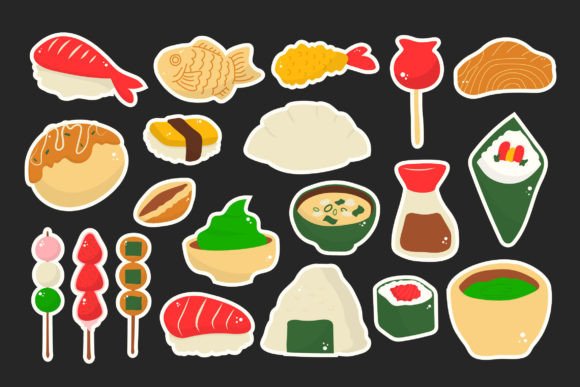
Bringing Authentic Flavor to Visual Projects with Japanese Food Illustration
When you are building a brand or a marketing campaign related to the culinary world, especially Asian cuisine, generic stock images often fall short. They lack the specific cultural nuance and the playful yet sophisticated aesthetic that resonates with food lovers. This is where a dedicated Japanese Food Illustration Set becomes an invaluable asset. It is not just a collection of random drawings; it is a curated system of visual language designed to evoke the warmth, precision, and artistry of Japanese gastronomy. Whether you are a designer working on a restaurant menu or a small business owner packaging artisanal snacks, having access to high-quality, cohesive illustrations can drastically elevate your visual hierarchy and brand perception.
The Anatomy of the Collection: Style and Specifications
Understanding the technical and aesthetic makeup of this set is the first step in leveraging its potential. Visually, these illustrations strike a balance between modern minimalism and traditional charm. You will likely find clean lines, consistent stroke weights, and a color palette that ranges from the natural earth tones of ingredients to the vibrant reds of lacquerware or the deep blue of ceramic patterns. This specific style works exceptionally well for modern typography pairings, allowing text to breathe without competing with the imagery.
From a technical standpoint, the specifications are built for professional versatility. The set includes 300 DPI resolution files, which is the standard for high-quality print work, ensuring that your visuals remain crisp even on large-scale banners or detailed packaging. The inclusion of vector formats like AI, EPS, and SVG files means you have infinite scalability. You can shrink an icon for a mobile app or blow it up for a trade show backdrop without losing a pixel of clarity. Furthermore, the editable color style allows you to shift the hue and saturation to match your specific brand identity. If your brand uses a specific shade of matcha green or torii red, you can adjust the illustrations to fit seamlessly.
Practical Applications Across Industries
The utility of a Japanese Food Illustration Set extends far beyond simple decoration. For packaging design, these assets are essential. Imagine a box of artisanal mochi; the illustration of the rice cakes on the side panel immediately communicates the product inside, adding a layer of hand-crafted authenticity. For editorial design, such as food blogs or cookbook layouts, these illustrations serve as excellent dividers, spot graphics, or background textures that add flavor without distracting from the recipes.
In the digital space, the value is equally high. Social media graphics demand attention instantly. A vector icon of a steaming bowl of ramen or a sake bottle can serve as a strong focal point in an Instagram story or a Pinterest pin. Because the files are well-organized with labeled layers, you can easily isolate specific elements—like a pair of chopsticks or a specific sushi roll—to create custom stickers or interactive elements for your website. This level of customization is crucial for web design where unique design assets can reduce bounce rates by making the user experience more engaging.
Enhancing Brand Identity and Audience Engagement
Visual consistency is a pillar of trust. When your logo design, website, and physical marketing materials share a cohesive visual language, your brand appears more established and professional. This illustration set acts as a unifying thread. By using the same stylistic approach across your landing pages and physical menus, you reinforce brand recognition. Customers begin to associate that specific aesthetic with your business.
Moreover, illustrations often convey emotion better than photography. A photo of a dish can look appetizing, but an illustration can highlight the "personality" of the food. It can emphasize the steam, the texture of the seaweed, or the gloss of the sauce in a way that feels stylized and fun. This approach is particularly effective for targeting a younger demographic or families who appreciate a creative font style and playful imagery. It turns a transactional experience into a cultural one.
Strategic Integration: Pairing and Readability
Integrating these illustrations requires a strategic eye, particularly regarding typography. Since the illustrations likely have a hand-drawn or organic feel, pairing them with a stiff, corporate sans serif font might create visual dissonance. Instead, consider a serif font with some character, or a clean script font for headlines to complement the organic nature of the art. However, readability must remain the priority. Ensure that the background illustrations do not interfere with body text legibility. Use the illustrations as accents—headers, footers, or sidebars—rather than watermarks behind dense paragraphs.
Before finalizing your layout, test the font pairing with the illustrations at various sizes. Does the illustration overpower the text at 12px? Does the vector remain sharp on a 4K monitor? Because the set includes PNG files with transparent backgrounds, you can easily layer these assets over solid colors or gradients. This is particularly useful for creating depth in infographics where you need to visualize data points related to food categories.
Maximizing Your Investment in Design Assets
For entrepreneurs and content creators, efficiency is key. Having a library of pre-made, high-quality illustrations saves hours of commissioning custom art or sifting through low-quality stock sites. However, to maximize the value of this premium font and illustration set, you should treat it as a system rather than a collection of parts.
Start by mapping out your content needs. If you are a publisher, you might need icons for chapter headings. If you run a delivery app, you might need icons for your UI menu. The well-organized layers in the source files allow you to batch-edit colors or export specific slices efficiently. Always check the licensing terms to ensure your specific use case—whether commercial or personal—is covered, especially if you are using the assets for client work. By treating these illustrations as core components of your design toolkit, you ensure that every piece of content you produce feels intentional, culturally respectful, and visually appetizing.